
The Great Decoupling and the Traffic Apocalypse
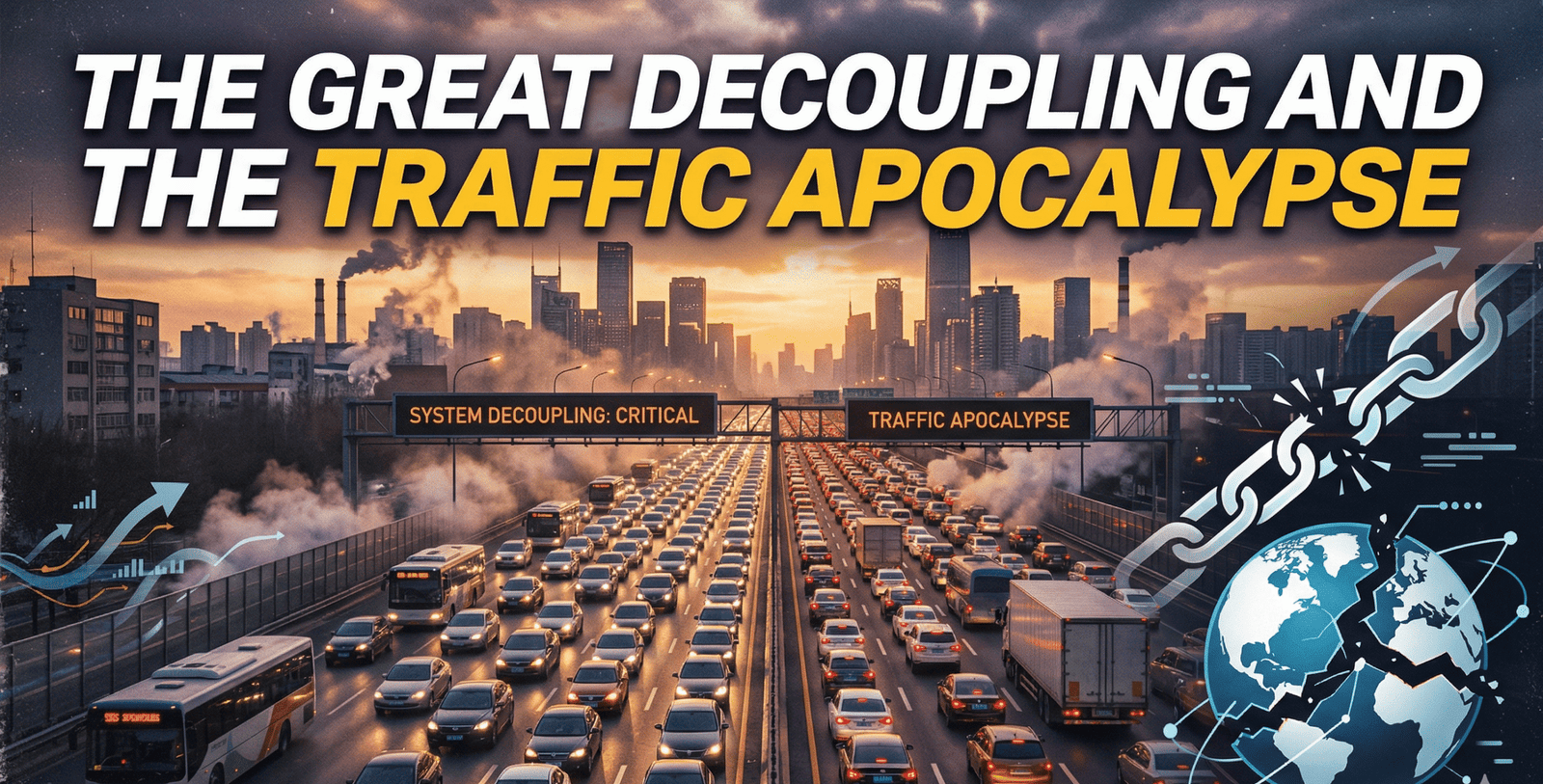
he fundamental shift in the 2025 digital economy is the transition from a “discovery” workflow to a “synthesis” workflow, fundamentally changing the relationship between SEO and AEO. In the legacy search paradigm, a user entered a fragmented query and was presented with a list of potential sources. This required the human to click, browse, and manually synthesize information from disparate pages.
Answer engines have collapsed this process. They act as sophisticated proxies that ingest, evaluate, and summarize information into a single, authoritative response. The interaction has moved from “search and browse” to “prompt and synthesize,” marking the definitive evolution of SEO and AEO strategies.
“The ecosystem has shifted from a referral engine, designed to direct users to distributed sources of information, to an ‘Answer Engine’ model, where platforms satisfy user intent directly within the interface or through conversational AI agents.” This shift makes the integration of SEO and AEO vital for brand survival.
This changes the macro-economic reality of content. In the synthesis era, your website is no longer the destination; it is an “answer layer” that feeds the AI. This is what we call “Liquid Content”—information that is extracted, reformulated, and consumed off-platform. The BUYER no longer needs to visit five vendor sites to create a comparison spreadsheet; the AI does it for them in under 300 milliseconds. If your content isn’t structured for this extraction through both SEO and AEO, you are effectively invisible to the synthesis layer.
1. Takeaway #1: The Move from “Discovery” to “Synthesis”
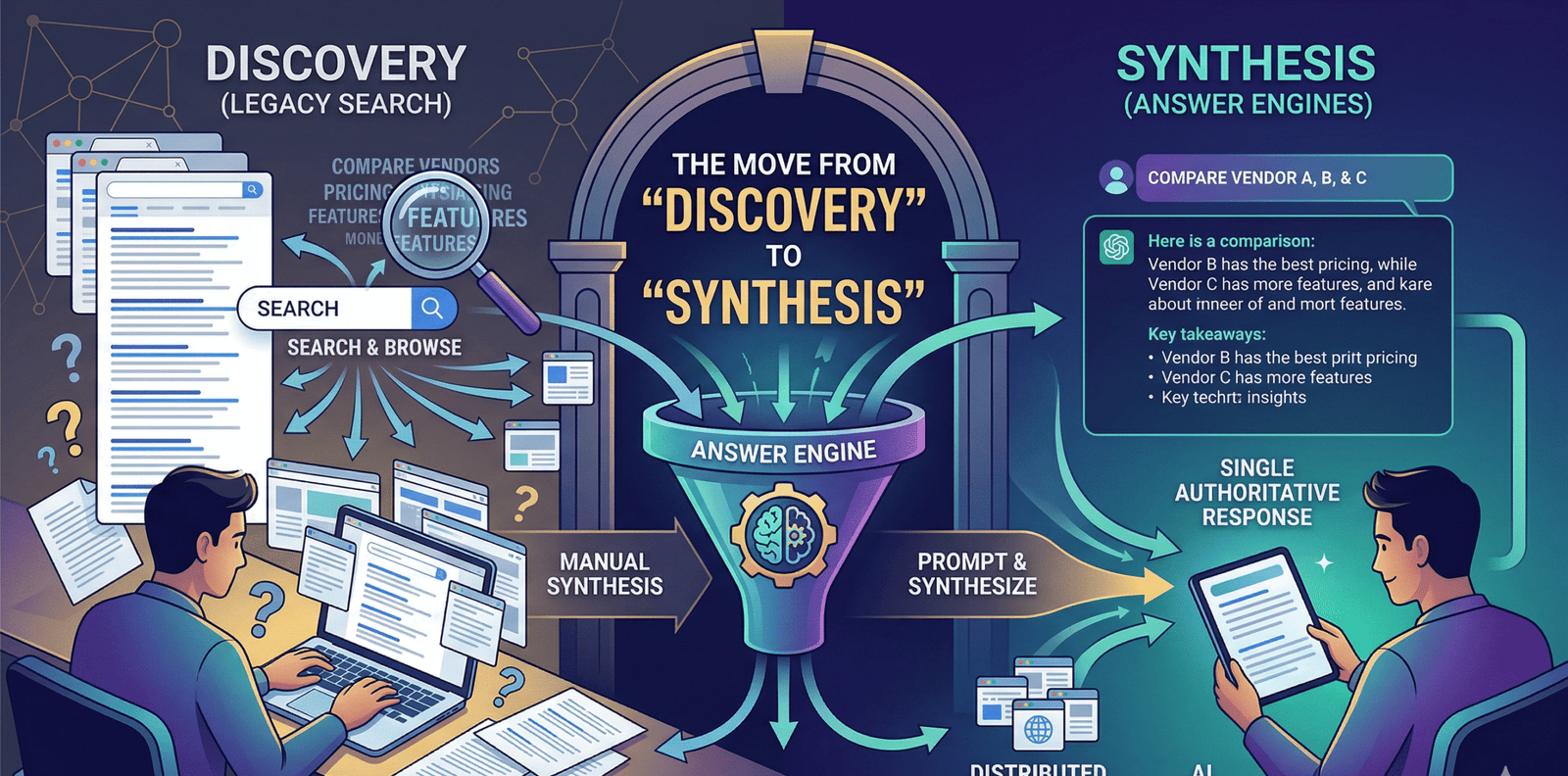
The fundamental shift in the 2025 digital economy is the transition from a “discovery” workflow to a “synthesis” workflow, fundamentally changing the relationship between SEO and AEO. In the legacy search paradigm, a user entered a fragmented query and was presented with a list of potential sources. This required the human to click, browse, and manually synthesize information from disparate pages.
Answer engines have collapsed this process. They act as sophisticated proxies that ingest, evaluate, and summarize information into a single, authoritative response. The interaction has moved from “search and browse” to “prompt and synthesize,” marking the definitive evolution of SEO and AEO strategies.
“The ecosystem has shifted from a referral engine, designed to direct users to distributed sources of information, to an ‘Answer Engine’ model, where platforms satisfy user intent directly within the interface or through conversational AI agents.”
This changes the macro-economic reality of content. In the synthesis era, your website is no longer the destination; it is an “answer layer” that feeds the AI. This is what we call “Liquid Content”—information that is extracted, reformulated, and consumed off-platform. The BUYER no longer needs to visit five vendor sites to create a comparison spreadsheet; the AI does it for them in under 300 milliseconds. If your content isn’t structured for this extraction through both SEO and AEO, you are effectively invisible to the synthesis layer.
The Evolution from SEO to AEO
2. Takeaway #2: Zero-Click is No Longer the Exception—It’s the Rule
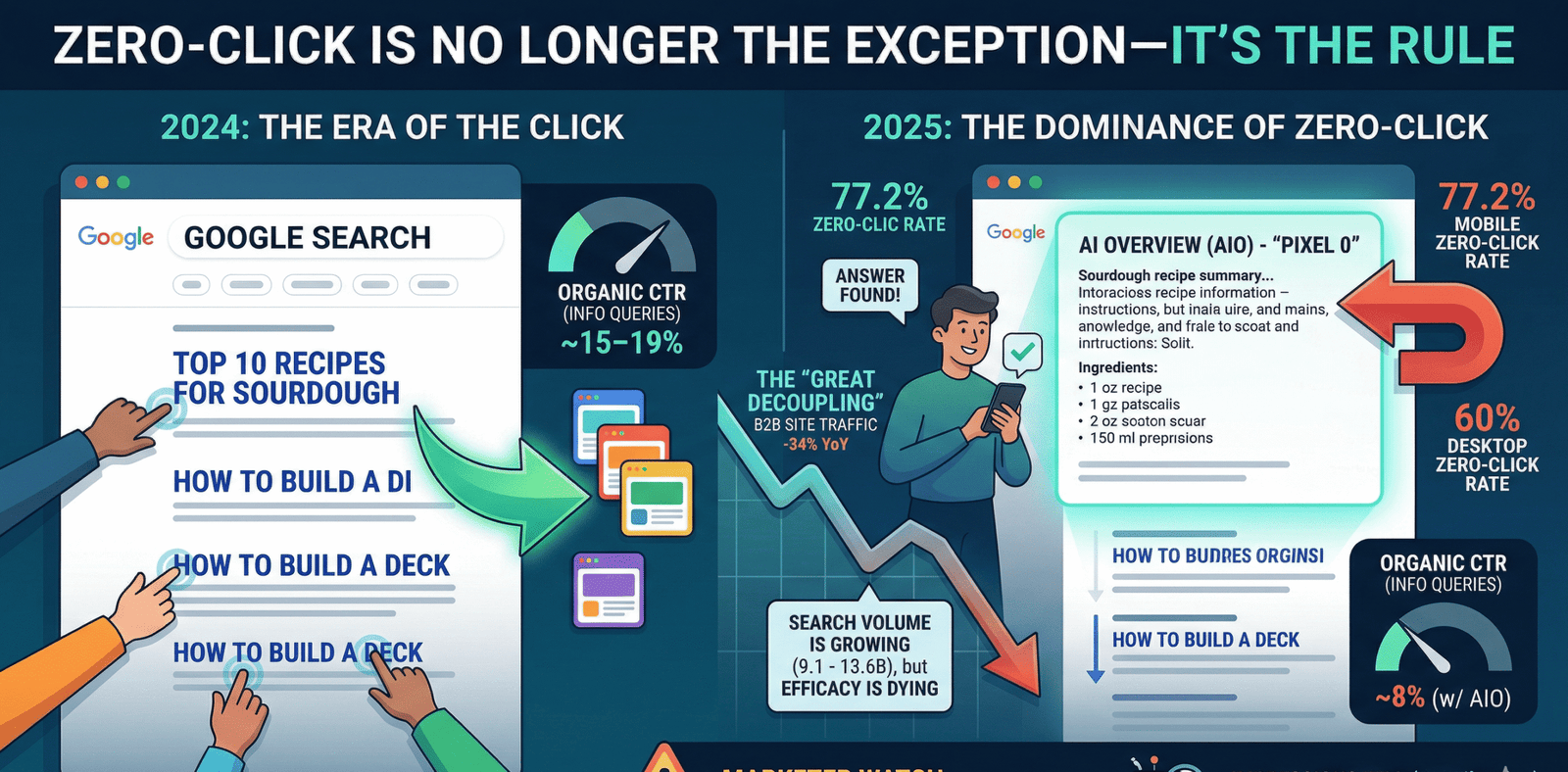
Zero-click searches—sessions where a user obtains a complete answer on the Search Engine Results Page (SERP) and departs without clicking a link—now represent the majority of search behavior. This dominance is driven by AI Overviews (AIO), which now occupy “Pixel 0,” the prime real estate above traditional organic results.
The 2025 Reporting Anomaly
Marketers must be wary of the “September 2025 Reporting Anomaly.” Google’s shift to infinite scroll, combined with aggressive bot filtration, caused a massive drop in “bot-inflated” impressions in Search Console. According to data from Search Engine Journal, clicks fell due to genuine zero-click behavior.
Zero-Click and CTR Metrics: 2024 vs. 2025
| Metric | 2024 Baseline | Present Status | Impact Analysis |
| Daily Google Searches | ~8.5 Billion | 9.1 – 13.6 Billion | Volume is growing, but efficacy is dying. |
| Desktop Zero-Click Rate | ~46.5% | 60% | The majority of desktop intent is satisfied on-SERP. |
| Mobile Zero-Click Rate | ~58% | 77.2% | Mobile is now almost exclusively an Answer Engine. |
| Organic CTR (Info Queries) | ~15–19% | ~8% (w/ AIO) | A 47–61% collapse in click-through efficacy. |
| B2B Site Traffic (Avg) | Baseline | -34% YoY | The “Great Decoupling” in hard numbers. |
This data illustrates the “B2B SEO Paradox”: a brand’s rankings can technically improve while its traffic declines. When Google summarizes your educational guide on “Enterprise ERP Implementation,” the user gets the value, but the vendor gets no pixel fire, no lead, and no visit.
3. Takeaway #3: The SEO vs. AEO vs. GEO Strategic Framework
To survive in a “Search Everywhere” environment, we must distinguish between three overlapping but distinct visibility models.
The Search Everywhere Optimization Matrix
| Feature | SEO (Traditional) | AEO (Answer Engine) | GEO (Generative Engine) |
| Primary Goal | Drive sessions/clicks. | Deliver direct answers. | Influence LLM recommendations. |
| Search Behavior | Keyword-driven stubs. | Natural language/Voice. | Conversational research. |
| Hardware / Interface | Desktop/Mobile SERP. | Voice (Alexa/Siri), NPUs. | LLMs (ChatGPT, Claude). |
| Hardware Metric | Page Load Time. | <300ms Latency. | Training Data Presence. |
| Metric of Success | Organic Traffic/CTR. | Citation Frequency/AARS. | Share of Model/Sentiment. |
The Hardware Revolution
As an AI Futurist, I cannot overstate the impact of the hardware revolution on these strategies. The global AI speech recognition chip market is growing at a 23% CAGR, reaching $7.01 billion by 2032. With 8.4 billion active voice devices and new Neural Processing Units (NPUs) in mobile devices, search is moving from text-based queries to “speech-native” architectures. This is not just “voice search”; it is real-time processing that detects sarcasm, stress, and intent, bypassing the traditional web browser entirely.
4. Takeaway #4: The 40-60 Word “Sweet Spot” for Answer Density
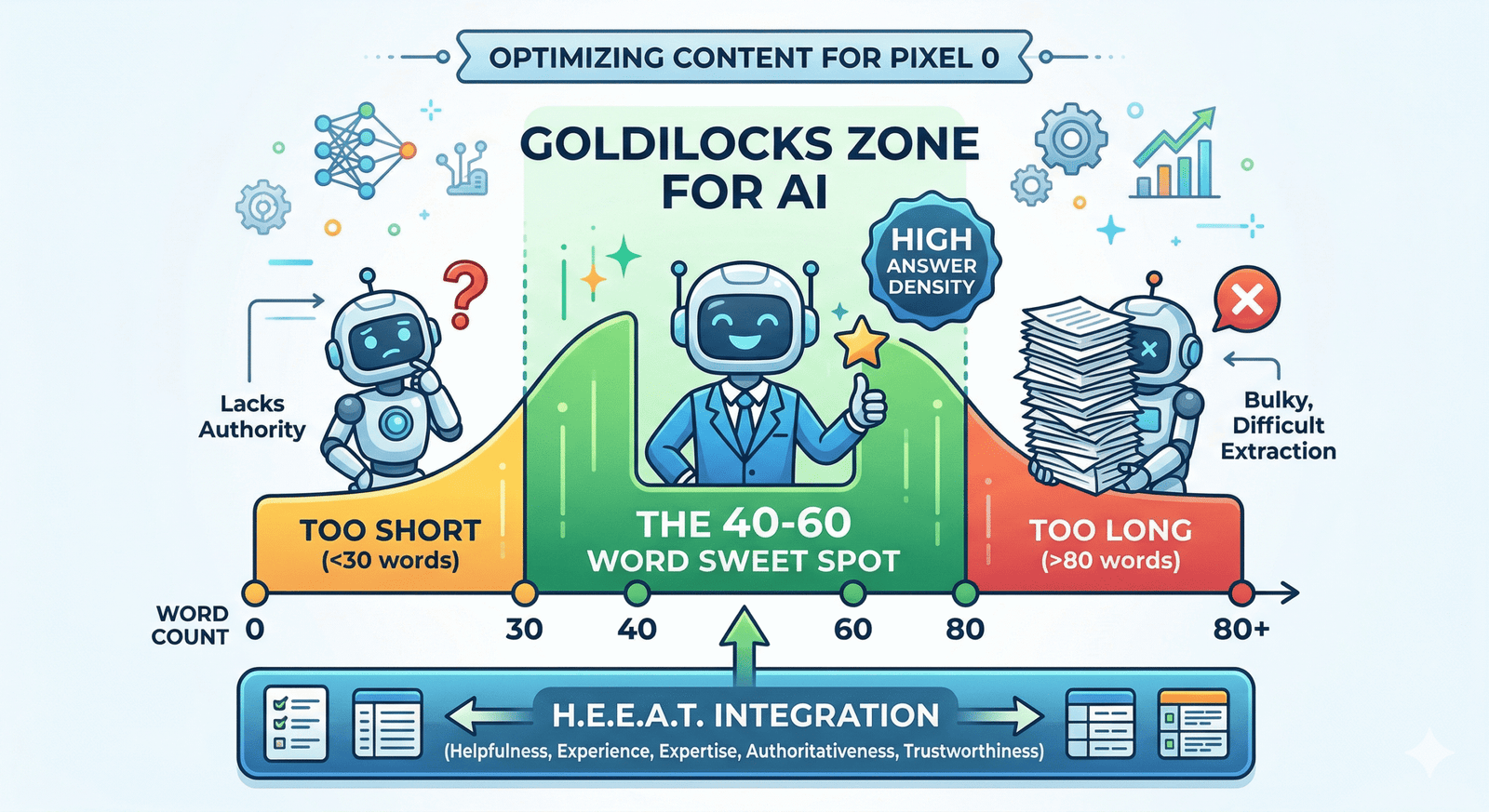
AI engines do not read; they extract. They prioritize “answer density”—the number of complete, factual answers per unit of text. To capture Pixel 0, you must utilize a “Pyramid Structure” for your content engineering:
- The Definitive One-Sentence Opening: Every section must lead with a concise answer. This is your “Self-Contained” requirement. The answer must be understandable without the rest of the page.
- The 40-60 Word Constraint: This is the “Goldilocks Zone.” Research indicates AI models struggle with answers under 30 words (seen as lacking authority) or over 80 words (too bulky for extraction).
- H.E.E.A.T. Integration: We have evolved beyond E-E-A-T to include “Helpfulness.” AI prioritizes content that provides immediate utility through lists, tables, and structured data.
If your content is buried in a 2,000-word narrative without these extraction points, the AI will bypass you for a more “dense” source.
5. Takeaway #5: Technical Infrastructure—From Robots.txt to llms.txt
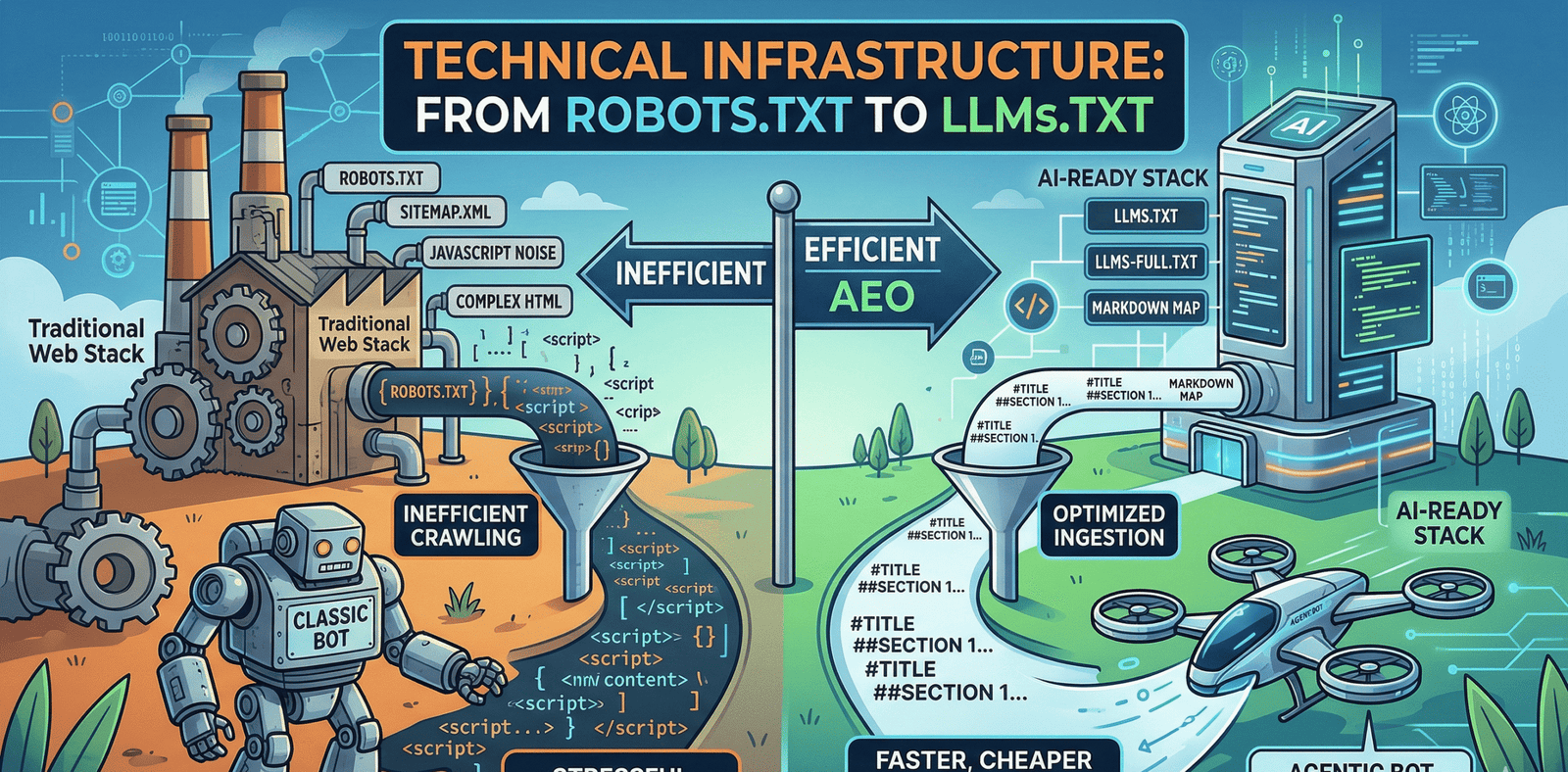
The technical stack for AI-readiness has expanded. While robots.txt manages access and sitemap.xml provides a full index, they are insufficient for the “Agentic” era. We are now seeing the rise of llms.txt and llms-full.txt.
- llms.txt: A curated Markdown map of your site’s highest-value content. Think of it as a “Cliff’s Notes” for AI crawlers like GPTBot and ClaudeBot.
- Markdown over HTML: Serving Markdown variants can result in a 10x token reduction for AI agents. By reducing the “noise” of JavaScript and complex HTML, you make your site cheaper and faster for AI to ingest, significantly increasing your chances of being cited.
- Server-Side Rendering (SSR): Many AI crawlers still struggle with JavaScript-heavy client-side rendering. Ensuring your documentation is available via SSR is a baseline technical requirement for AEO.
6. Takeaway #6: Entity-Based SEO and the “Semantic Gap”
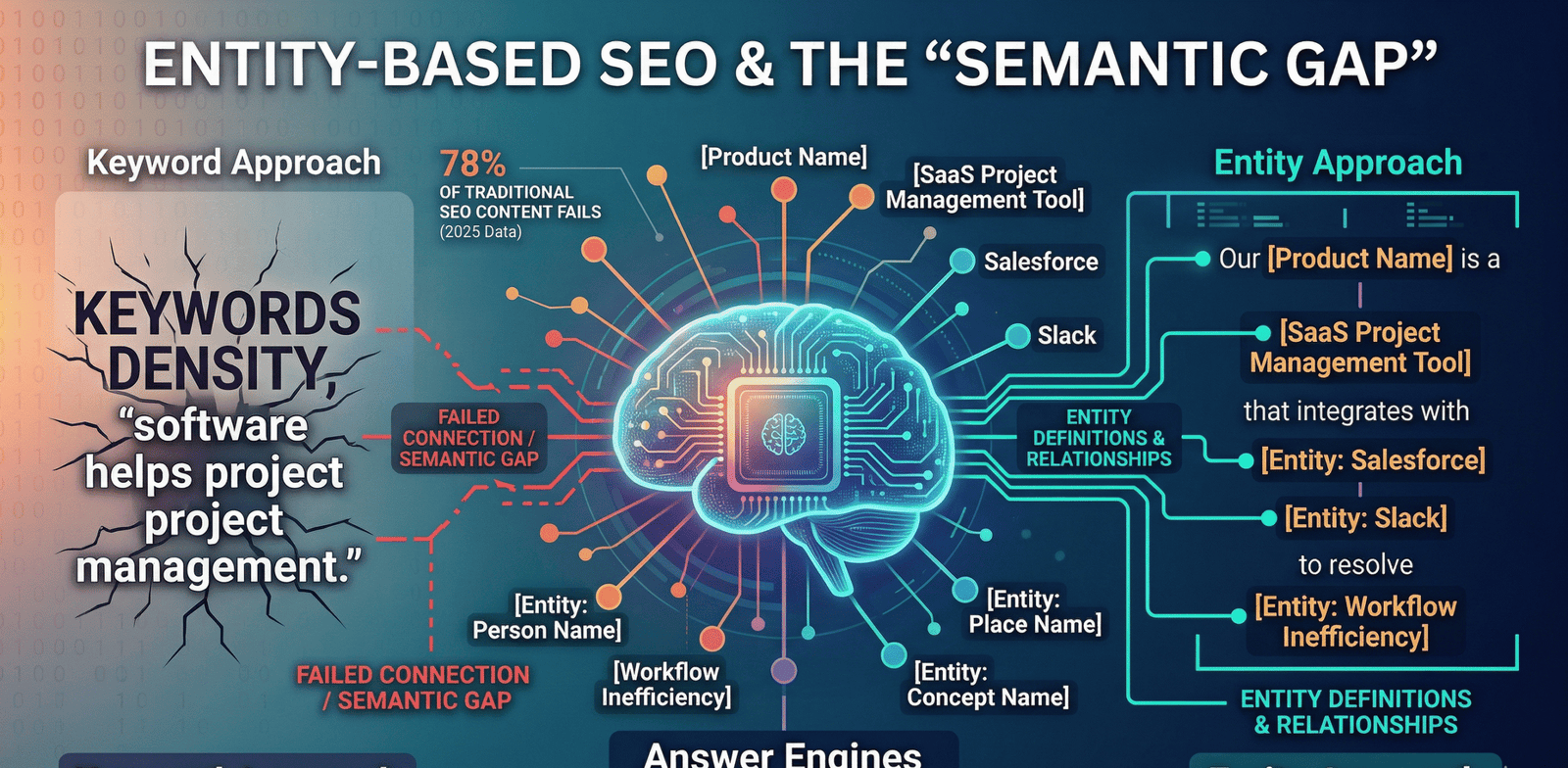
We have moved from keyword density to entity authority. An entity is a recognized concept or brand. The “Semantic Gap” explains why 78% of content fails today. You must bridge this by ensuring your brand is consistently defined across Knowledge Graphs like Wikipedia and Reddit. If the machine doesn’t recognize you as an entity, you won’t be recommended.
The “Semantic Gap” is the primary reason 78% of traditional SEO content fails in 2025. Most content lacks “explicit entity definitions.”
- Keyword approach: “Our software helps with project management.”
- Entity approach: “Our [Product Name] is a [SaaS Project Management Tool] that integrates with [Entity: Salesforce] and [Entity: Slack] to resolve [Entity: Workflow Inefficiency].”
LLMs are trained on massive datasets like Common Crawl (62% of GPT-3 training data), Wikipedia, and Reddit. To bridge the Semantic Gap, your brand must be consistently defined across these Knowledge Graphs. If Wikipedia and Reddit don’t recognize your brand as an authority in your niche, the AI will not recommend you, regardless of how many backlinks you have.
7. Takeaway #7: Case Studies in Survival—Adapters vs. Victims
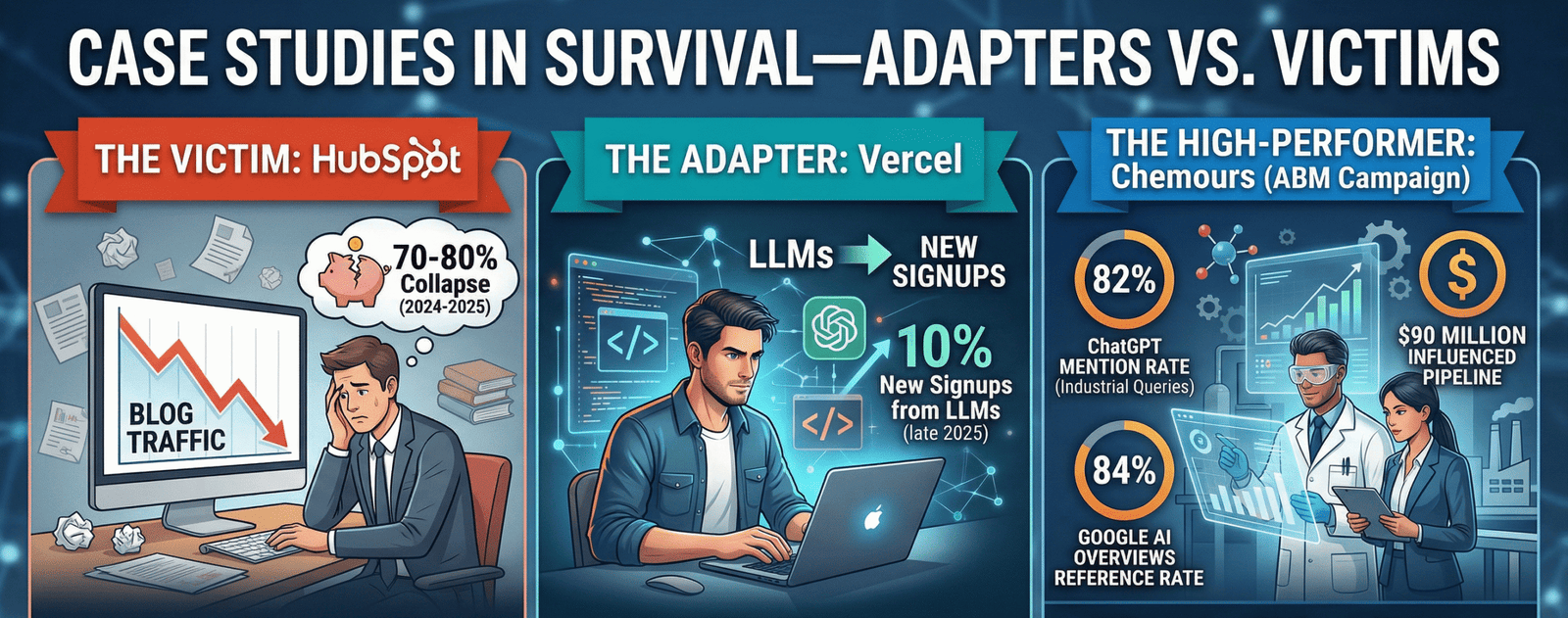
The results of the shift are now quantifiable. We see three distinct paths:
The Victim: HubSpot
The pioneer of Inbound Marketing became a primary victim of its own success. By dominating high-volume, generic “how-to” content (e.g., “how to write a resignation letter”), HubSpot built a traffic moat that AI effectively evaporated. Between 2024 and 2025, their blog traffic collapsed by 70–80%. The strategic lesson: Generic information is now a commodity owned by the engine. However, HubSpot noted that only 10% of their leads came from this traffic, proving that “vanity traffic” was the first casualty of the Apocalypse.
The Adapter: Vercel
Vercel moved from keyword volume to “Concept Ownership.” By creating high-density, Markdown-ready documentation for “frontier concepts,” they turned ChatGPT into a primary acquisition channel. By late 2025, 10% of new signups originated from LLM referrals, proving that AEO can drive bottom-of-funnel conversions.
The High-Performer: Chemours (The ABM Agency Campaign)
Chemours unified 12 regional websites into a single AEO-optimized knowledge hub. By focusing on product databases and comparison content, they achieved:
- 82% mention rate in ChatGPT for industrial queries.
- 84% reference rate in Google AI Overviews.
- $90 million in influenced pipeline. This was achieved by winning the “Share of Voice” against competitors like Tronox and Venator, who remained stuck in legacy SEO.
The AI-Native Grower: Workfellow
Facing giants like SAP, Workfellow used a “Human + AI” content model to scale depth rather than just volume. By targeting “High-Potential, Low-Competition” comparison keywords, they achieved a 22x increase in traffic and a 5x increase in MQLs in just 12 months.
8. Takeaway #8: The Conversion Paradox—Quality Over Quantity
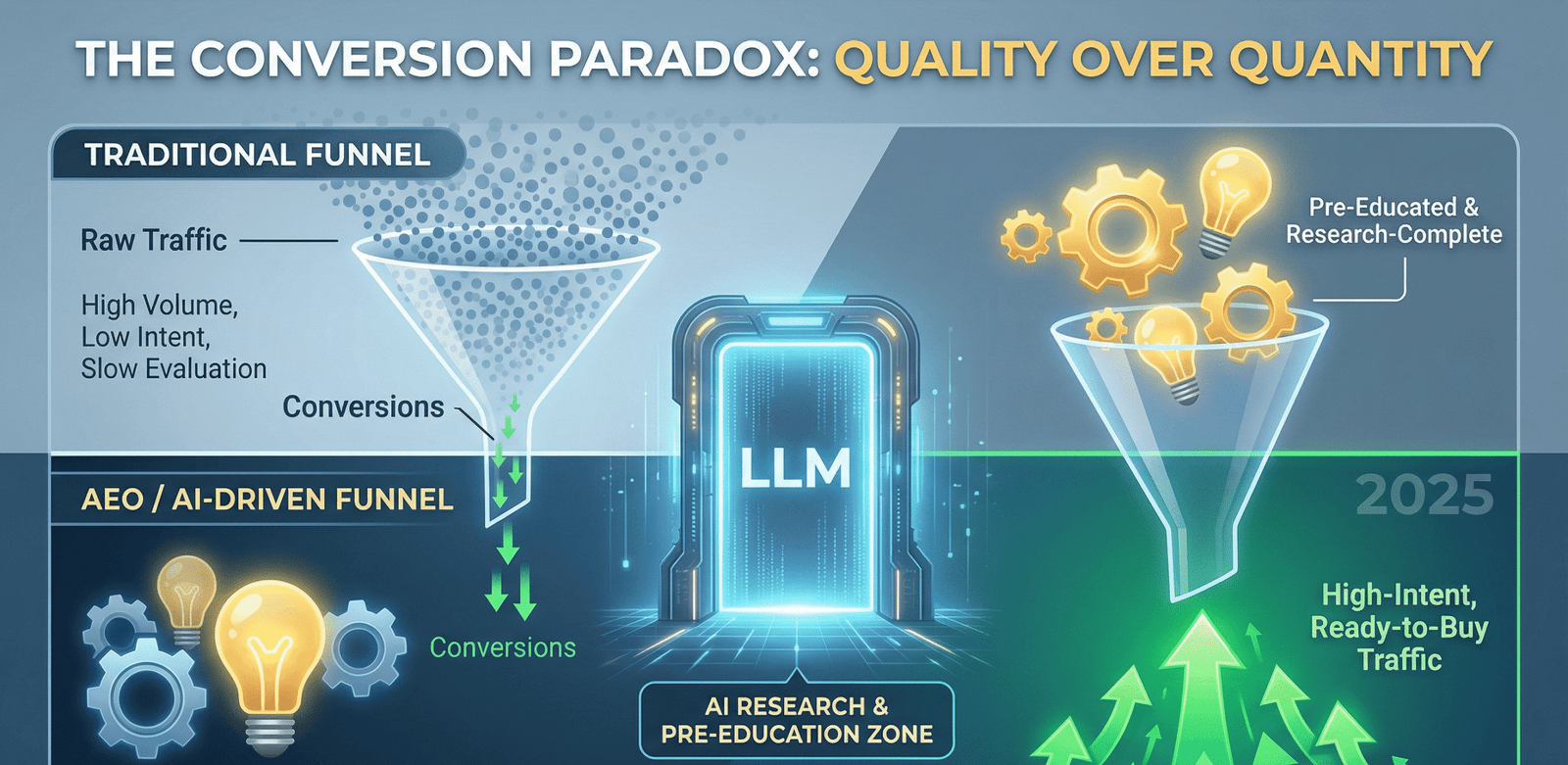
While AEO reduces raw traffic, it produces a “Conversion Paradox.” Users conduct extensive research and “pre-education” within the AI interface. By the time they click a citation to visit your site, they are significantly further down the funnel.
2025 Conversion Data: LLM Referrals vs. Organic Search
| Sector | LLM Referral Conversion | Organic Search Conversion | Variance |
| Healthcare / MedTech | 3.76% | 1.19% | +215.9% |
| eCommerce / B2B | 5.53% | 3.70% | +49.4% |
While you may have fewer visitors, those visitors are “pre-qualified” by the machine. The AI acts as a digital filter, delivering high-intent buyers who no longer need top-of-funnel education—they need a transaction.
9. Takeaway #9: The Rise of Agentic AEO and 2026 Predictions
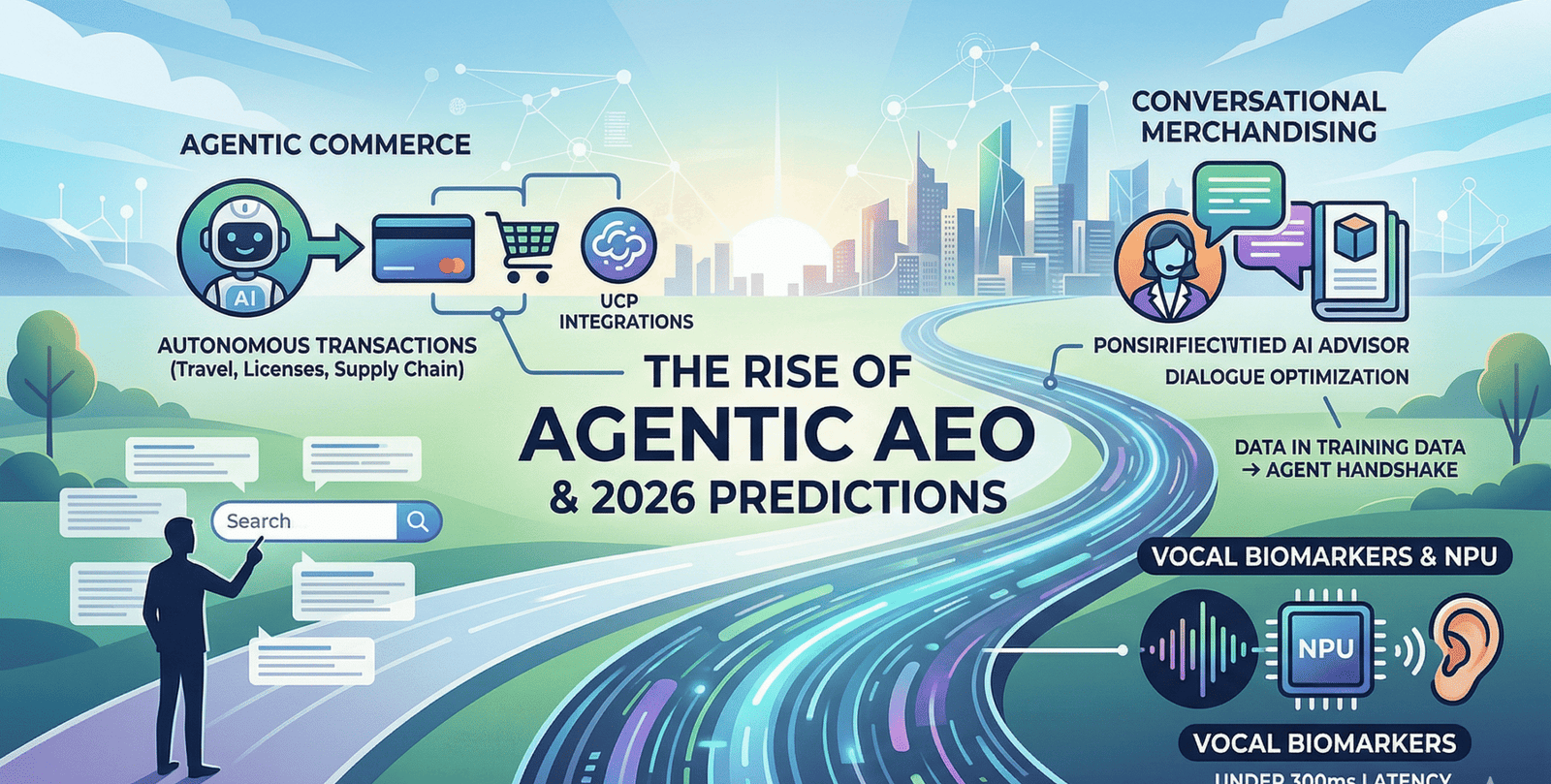
The evolution toward Agentic AEO represents a paradigm shift where the internet moves from a passive library of information to an active network of autonomous executors. In this 2026 landscape, the primary consumer of your website’s data is no longer a human browsing via a screen, but an AI agent acting as a digital proxy. These agents utilize Unified Commerce Platforms (UCP) to bridge the gap between “knowing” and “doing,” meaning they don’t just research the best enterprise cloud solution or logistics provider—they negotiate terms, verify compliance against pre-set company policies, and initiate the procurement process through API-driven handshakes.
To thrive in this environment, your brand’s technical infrastructure must move beyond human-readable aesthetics and prioritize agentic interoperability. This involves deploying comprehensive schema markups, maintaining high-fidelity product feeds, and ensuring your “liquid content” is structured in a way that allows an AI to verify real-time availability and pricing without human intervention. If your brand lacks this machine-readable “handshake” capability, you essentially lock yourself out of the Agentic Commerce ecosystem, becoming invisible to the very bots that are now authorized to manage 2026’s supply chains and corporate budgets.
Conclusion: Winning the Citation, Not Just the Rank
The sunset of the “Ten Blue Links” signifies more than just a change in search engine layouts; it represents a fundamental shift in how human knowledge is indexed and retrieved. In this new era, the traditional obsession with click-through rates (CTR) must give way to a focus on Citation Authority. Being the first result on a page is meaningless if a generative AI summarizes your entire value proposition without ever mentioning your brand name. As we move into 2026, the modern strategist must treat their digital presence as a distributed knowledge base rather than a mere destination. Success is no longer measured by the volume of visitors hitting your landing page, but by the frequency with which your data points, unique insights, and brand entities are synthesized into the AI’s final response. To win, you must provide “liquid content” that is structured, verifiable, and authoritative enough for an LLM to trust it as a primary source of truth.
For a platform like bytbloom.com, this shift offers a massive competitive advantage. By focusing on high-density, technical clarity in the realms of productivity and AI tools, bytbloom can position itself as the definitive “answer layer” for users navigating the complex intersection of finance and technology. Instead of just fighting for a spot in a crowded search results list, the goal for bytbloom is to become the underlying data source .